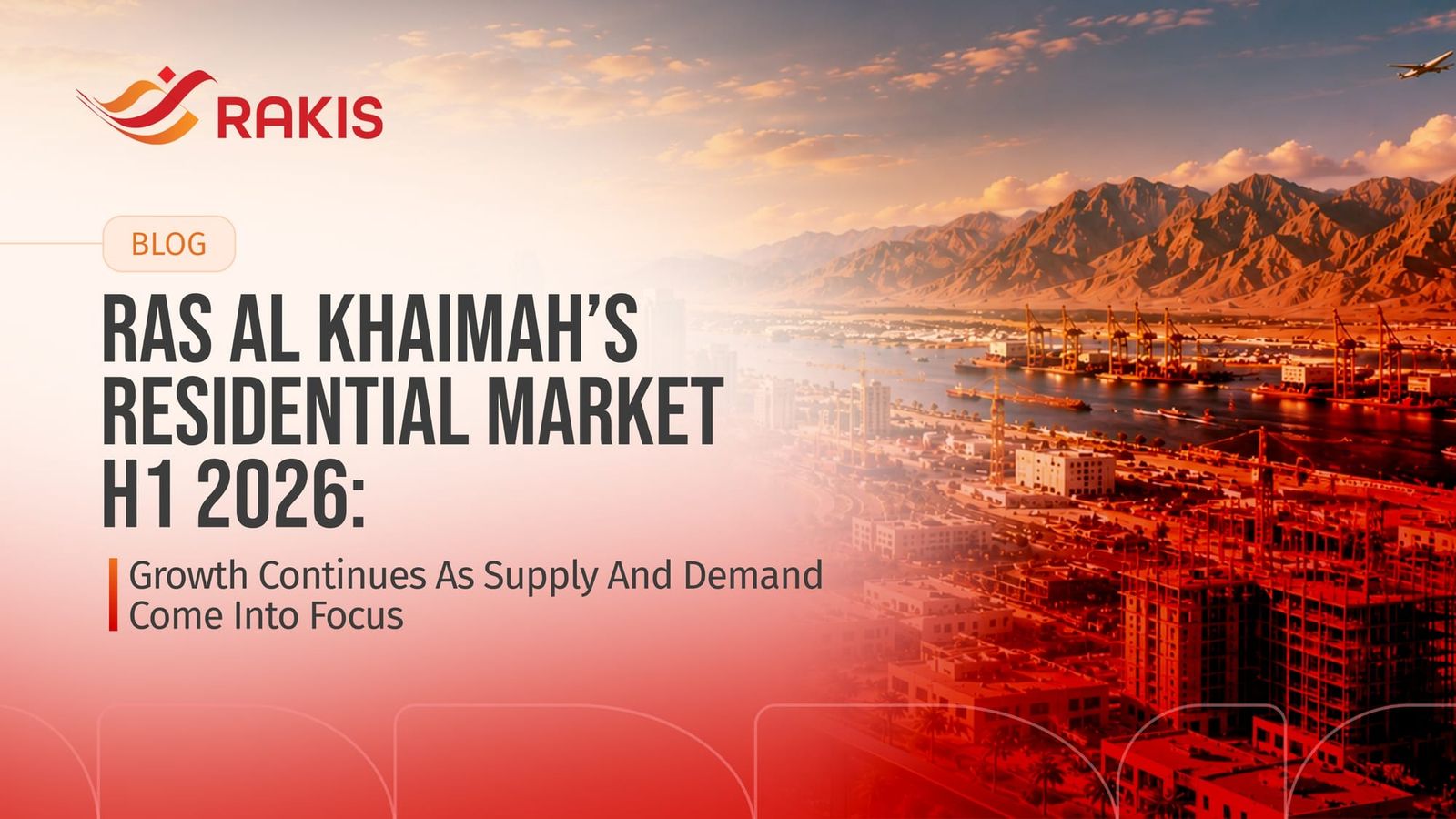
Ras Al Khaimah’s Residential Market H1 2026: Growth Continues as Supply and Demand Come Into Focus
Ras Al Khaimah’s residential market entered the second half of 2026 on a relatively resilient footing, supported by continued investment, business formation and employment growth.

First published onRAKIS ↗
Ras Al Khaimah’s residential market entered the second half of 2026 on a relatively resilient footing, supported by continued investment, business formation and employment growth. At the same time, recent moderation in sales prices and rental rates suggests that market conditions are becoming more measured as new supply approaches and broader economic uncertainty influences buyer and tenant sentiment.
According to Cavendish Maxwell’s Ras Al Khaimah Residential Market Performance H1 2026, the emirate attracted AED 771.5 million in new investment during the first half of the year, while 967 new businesses joined the Ras Al Khaimah Chamber of Commerce. The report also records growth in employment and commercial activity, providing an important economic foundation for residential demand.
Residential Transactions Show Resilience
The freehold ready residential market recorded AED 625.2 million in transaction value during H1 2026.
While this represented a 3.3% decline year-on-year, the market recorded a stronger performance compared with the previous six months, with transaction values 24.1% higher than H2 2025.
The performance varied between property types. Villa transaction values declined 7.4% year-on-year to AED 297.7 million, while apartment transactions remained broadly stable, increasing 0.7% to AED 327.6 million.
The quarterly picture was stronger. Total transaction values reached AED 353.8 million in Q2 2026, representing a 30.3% increase compared with Q1 and remaining broadly in line with the same period in 2025. Apartments accounted for AED 155.6 million, while villas contributed AED 198.2 million.
Prices Remain Above 2025 Levels, Despite Recent Moderation
Residential sales prices continued to record annual growth during H1 2026.
Apartment prices increased by 6.5% year-on-year, while villa prices rose by 5.9%. However, the pace of growth has started to ease. Over the previous three months, apartment prices declined by 0.7%, while villa prices fell by 0.2%.
The report attributes this recent easing to a more cautious approach among buyers amid broader macroeconomic uncertainty.
Rental performance also remained positive on an annual basis. Apartment rents increased by 7.1%, while villa rents rose by 8.0% over the past 12 months.
However, the short-term picture was more mixed. Apartment rents declined by 1.4% over the past three months, while villa rents increased by 0.9%, indicating greater variation between the two segments.
A Significant Supply Pipeline Is Taking Shape
One of the most important developments highlighted in the report is the expected increase in residential supply.
Around 600 units were completed during H1 2026, with approximately 1,600 additional units expected in H2 2026.
The pipeline then increases considerably, with around 4,700 units expected in 2027 and 7,500 units forecast for 2028.
This shift will make demand absorption increasingly important for the market.
Cavendish Maxwell notes that the ability to absorb this incoming supply will depend on continued employment growth and the emirate’s ability to attract and retain residents. Infrastructure development, improved connectivity and community amenities are also expected to play a supporting role in strengthening Ras Al Khaimah’s residential appeal.
Economic Growth Continues to Support Housing Demand
The residential market cannot be viewed separately from the wider economic performance of the emirate.
During H1 2026, Ras Al Khaimah attracted AED 771.5 million in new investment, while 1,399 investors from 68 nationalities were brought to the emirate through new investment activity. These investments are expected to generate approximately 2,449 new jobs.
The RAK Economic Zone’s commercial licence base reached 63,258 by June 2026, while commercial employment increased to 85,989, compared with 67,107 at the end of 2025. Industrial employment stood at 61,527 at the end of H1 2026.
These indicators point to continued economic activity and provide an important foundation for housing demand.
At the same time, the report highlights several factors that could influence the near-term outlook, including rising inflation and regional geopolitical uncertainty. The Consumer Price Index increased 4.9% year-on-year in June 2026, potentially placing additional pressure on household costs.
Wynn Al Marjan Island Could Become an Important Demand Catalyst
The anticipated opening of Wynn Al Marjan Island is identified in the report as a key medium-term catalyst for the residential market.
Its potential impact extends beyond tourism. The development could support additional employment, increase tourism inflows and generate further housing demand, particularly in communities close to Al Marjan Island.
As the development pipeline expands, the relationship between major destination projects, employment creation and residential demand will be an important factor to watch.
What Could Shape the Market in H2 2026?
The second half of 2026 will be an important period for Ras Al Khaimah’s residential market.
On one side, continued investment, business formation and employment growth provide supportive fundamentals. On the other, the market is approaching a period of significantly higher residential supply, while recent price and rental moderation suggests that buyers and tenants are becoming more cautious.
The key question will be whether population, employment and investment growth can keep pace with the incoming residential pipeline.
As Cavendish Maxwell’s analysis indicates, H2 2026 should provide greater clarity on whether recent moderation in prices and rents represents a temporary adjustment or the beginning of a broader shift towards more measured market conditions.
Ras Al Khaimah’s Residential Market: A Market to Watch
Ras Al Khaimah’s residential market is entering an important phase of development.
The H1 2026 performance presents a market with continued economic support, positive annual price and rental growth, resilient transaction activity and a substantial development pipeline. At the same time, the scale of upcoming supply and evolving market sentiment will require close attention.
For developers, investors, property professionals and businesses operating across the real estate ecosystem, understanding how these factors interact will be essential as Ras Al Khaimah continues to develop its residential and wider investment landscape.
RAKIS 2026 brings together the developers, investors, government entities, business leaders and industry experts shaping this growth, providing a platform to explore the opportunities and trends influencing Ras Al Khaimah’s next phase of development.
📍 11–12 November 2026📍 RAK Exhibition Center, Ras Al Khaimah
Secure Your Place at RAKIS 2026