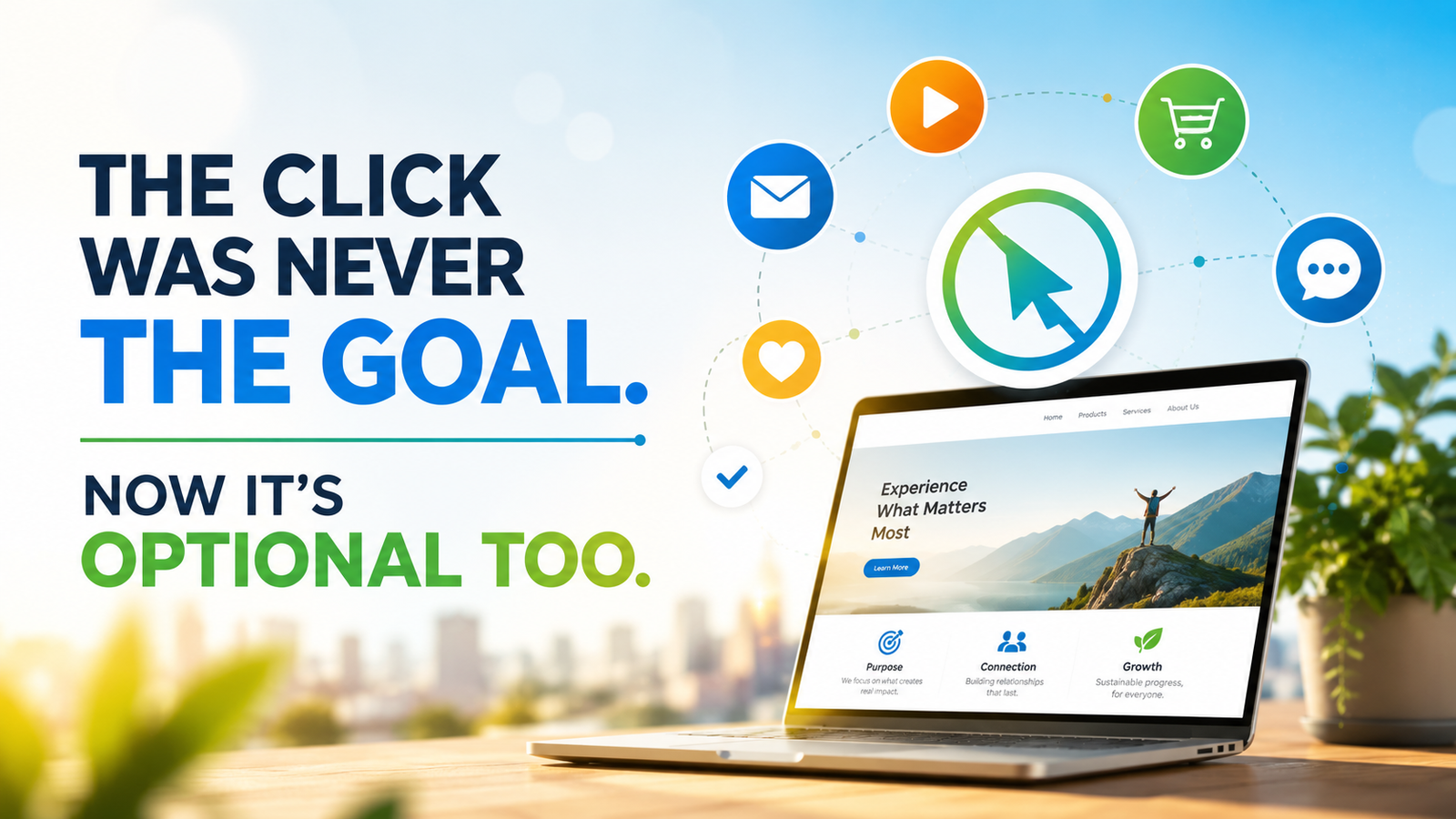
The Click Was Never the Goal. Now It's Optional Too.
First published onEventackle ↗
What zero-click search means for event and exhibition marketers, and what to actually do about it
Two-thirds of Google searches in the US now end without a click. SparkToro and Similarweb's research covering the first four months of 2026 puts the figure at just over 68%, the fastest two-year jump the metric has seen since it was first tracked. Only around 276 out of every 1,000 searches now reach the open web at all.
If you run marketing for an exhibition, conference, or trade show, sit with that for a second. Your registration funnel, your speaker pages, your exhibitor prospectus, your entire top of funnel, has quietly assumed for fifteen years that a search leads to a click leads to a website visit. That assumption is now wrong more often than it's right.
Why this hits event marketing harder than most sectors
B2B buyers have moved fast on AI-native research. Around 79% now use tools like ChatGPT, Perplexity, or Google's AI Overviews to research options before they land on a vendor site, according to recent B2B marketing trend data. For someone deciding whether to attend, exhibit at, or sponsor an event, that means the comparison, the shortlist, and half the decision can happen before your event page ever loads.
There's a strange tension sitting underneath this. While discovery goes AI-native, the product event marketers sell is doing the opposite: 49% of B2B organizations are increasing in-person event budgets this year, driven by relationship fatigue with all-digital selling. People want more face-to-face time even as the path to finding that face-to-face time gets less visible. That's the problem worth solving: how do you stay discoverable in a search layer that's optimizing to keep people away from your website, for an experience that only works if they eventually show up in person.
AI Overviews change the shape of the funnel, not just the traffic number
When an AI Overview appears on a query, click-through to the underlying sites drops by roughly 18% on average. The clicks that do survive convert better, since the visitor has already read a summary and is choosing to go deeper rather than browsing cold. That's the practical shift: fewer, higher-intent visits replacing a larger volume of casual ones.
For an event brand, that reframes what a "good" page looks like. A page written to hold someone's attention for three minutes and walk them through a journey is optimised for a world where people land on it by accident. A page written to answer the three questions an AI Overview would extract, then convert the visitor who chose to click anyway, is optimized for the world we're actually in now.
What to actually change
Write for extraction, then for humans. Put the direct answer, dates, location, who it's for, what it costs, near the top of every page in plain sentences, not buried in a hero banner or a PDF. Structured data (schema markup for events, speakers, and sessions) makes it far easier for an AI Overview or an AI Mode result to lift accurate facts about your event instead of guessing or, worse, citing a directory listing you don't control.
Treat first-party data as the thing AI search can't touch. Public content gets summarised, scraped, and reused by AI systems whether you like it or not. A buyer-seller intelligence file, a segmented delegate database, or a return-on-investment benchmark built from your own event history can't be replicated by a language model, because it doesn't exist anywhere for a model to find. That's less a defensive move and more the actual growth lever: the harder AI makes it to differentiate on public content, the more a proprietary audience asset is worth to sponsors and exhibitors.
Change what you measure. Organic sessions will keep declining even as awareness holds steady or grows, so a flat or falling traffic number stops being the whole story. Track branded and direct search volume, since that's a decent proxy for how often your event gets recommended inside an AI answer without a click ever following. If you can pull it, keyword-level impression data for your own name is a better leading indicator right now than click-through rate.
Lean harder into the channels that never depended on Google anyway. LinkedIn outreach, Dripify sequences, segmented email, sales conversations with exhibitors: none of that traffic ever ran through an SERP, so none of it is exposed to this shift. As generic search traffic gets thinner, the relative value of a well-targeted, permission-ed list goes up.
A short audit for your next event page
- Does the top of the page answer what, when, where, and who it's for in the first two sentences, without needing a scroll?
- Is event, session, and speaker data marked up with schema, or only living inside a PDF brochure?
- Does your FAQ section answer the actual questions a buyer or exhibitor asks, in their words, rather than the questions your team wishes they asked?
- If someone only ever sees a two-line AI summary of this page, does that summary still make them want to register?
Where this leaves us
SEO for events isn't dying. Its job is changing, from earning a click to earning a mention, and from optimising a page to optimising a fact set. The organisers who treat their audience and event data as a proprietary asset, and their public pages as a source AI systems can cite accurately, will keep showing up in the summary even when nobody clicks through to see it. The ones who don't will find out the hard way that fewer than three in ten searches reach a website at all anymore.