Shrinking Attention: A Marketer's Field Guide to Fighting for Seconds
First published onEventackle ↗
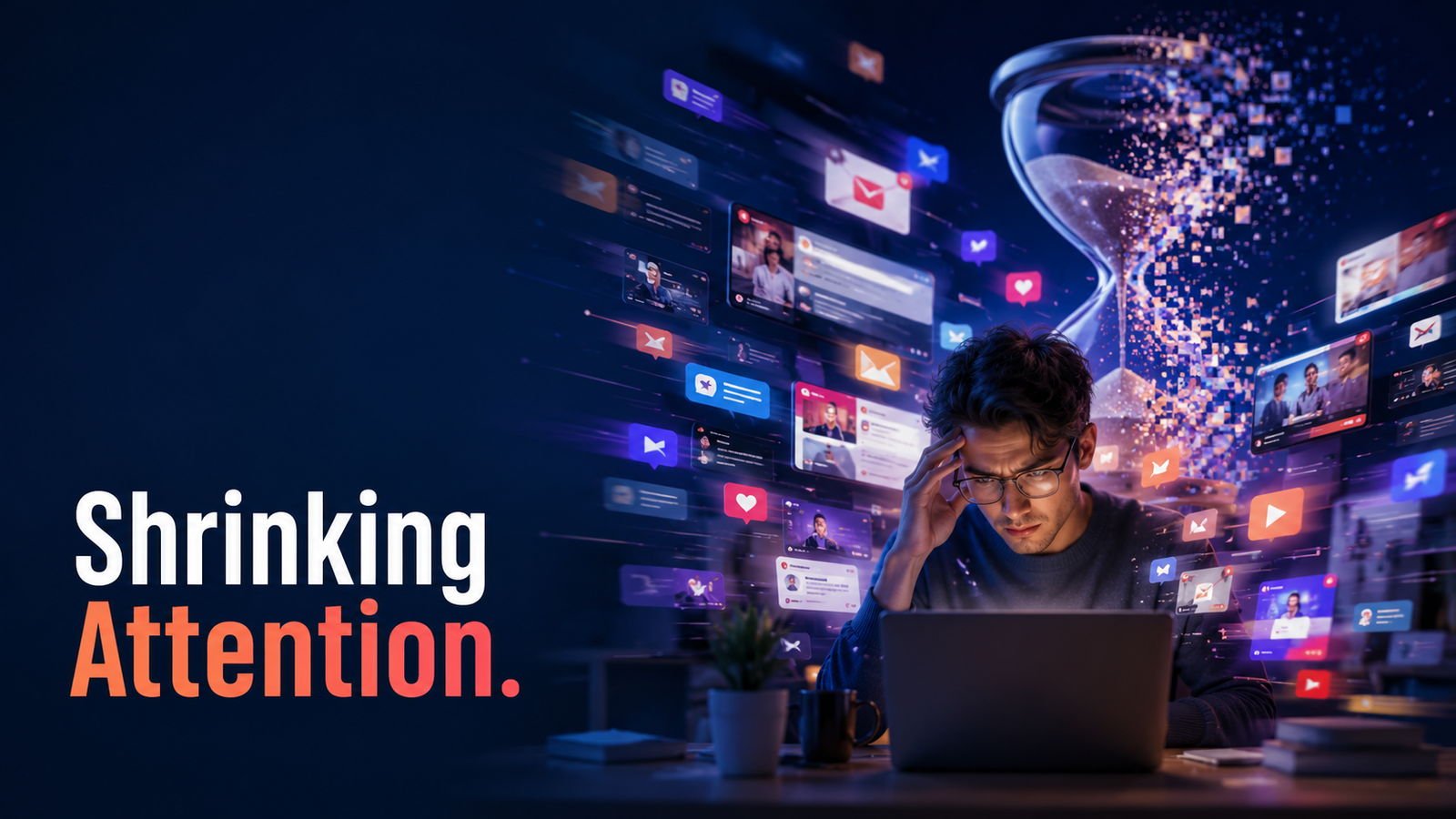
Eight seconds. That's the number marketers keep quoting when they talk about how long someone will look at anything before moving on. The figure dates back to a widely circulated Microsoft consumer insights report, and its methodology has been picked apart for years. Whether the true number is eight seconds or twelve doesn't really matter. What matters is the direction: every credible measure of digital behavior points the same way. Attention is getting more expensive, and it's being rationed in smaller and smaller units.
What the data actually says
Strip out the myth-adjacent stats (the goldfish comparison is a favorite, and it's not well supported), and the real picture is still stark.
People now open their phones close to a hundred times a day. Session lengths on platforms like Facebook have dropped from nearly 3 minutes in 2013 to under 1 minute today. Gen Z users on fast scroll platforms shift attention every 4 to 6.5 seconds per post, and app switching among under 25s has gone from roughly once every 2.5 minutes a decade ago to once every 44 seconds now. In a 2025 study, over half of respondents said they skip videos longer than 60 seconds even when the topic interests them.
None of this means people have stopped paying attention entirely. It means they've gotten ruthless about what earns it. Gen Z users who follow a creator they trust will happily sit through long-form content from that person, even as they swipe past everything else in seconds. Attention hasn't vanished. It's become conditional.
Why this happened
Three forces compound each other. First, volume: the average person is now exposed to thousands of pieces of content a day, up from a fraction of that a decade ago. Second, design: infinite scroll, autoplay, and algorithmic feeds are built to reward switching, not sticking. Third, competition: every brand, creator, and platform is optimizing for the same eight-second window, which means the bar for "worth stopping for" keeps rising even as the time available keeps shrinking.
For marketers, this isn't a content problem you can solve with better writing alone. It's a structural shift in how value gets proven to an audience.
What it means for how you work
The hook carries more weight than the message. Creators using a hook-in-the-first-three-seconds approach report substantial gains in average watch time. If your opening line, frame, or visual doesn't earn the next three seconds, the rest of the asset doesn't get evaluated on its merits. It gets evaluated on whether it existed at all.
Recall and reach are no longer the same metric. Short reels under 20 seconds can pull in far more likes and shares than longer content, but a large share of viewers won't remember the brand behind them. If your KPI is impressions, short-form wins easily. If your KPI is whether a prospect remembers who you are three weeks later, you need a different plan, not just a shorter cut of the same plan.
Scannability isn't a nice-to-have anymore. Pages with clear, scannable structure retain more readers than dense blocks of text, and the vast majority of mobile users never scroll past the first screen. Front-load the point. Say the important thing first, then support it.
Trust buys you longer attention. The audiences still willing to sit through longer content are doing it because they already trust the source. That's an argument for building a recognizable presence over time rather than treating every piece of content as a one-off bid for attention from strangers.
The B2B and events angle
This gets talked about mostly in a B2C, social-feed context, but it applies just as hard to B2B and event marketing, where the sales cycle is longer, and the content is often heavier. A delegate scrolling LinkedIn between meetings is applying the same eight-second filter to a webinar invite that they apply to a meme. The subject line, the first slide, the first ten words of an email segment all carry more of the burden than they used to.
That changes the shape of a campaign. Instead of one long asset (a whitepaper, a full session recording) doing the work of persuasion, the job shifts to producing a chain of small, high-signal moments — a sharp LinkedIn post, a 20-second clip pulled from a keynote, a two-line email that leads with the one stat that matters — that each individually earn enough attention to pull someone one step closer to the longer asset. The long-form content doesn't disappear. It just stops being the front door.
Where this leaves strategy
Shrinking attention doesn't lower the ceiling on what a brand can communicate. It raises the cost of admission. The content that used to get a fair read because it showed up in the right place now has to earn every second explicitly, from the first line onward. Plan for that from the first draft, not as a trim you make at the end.