Interview with Jelena Aleksić, Industry Decarbonization, Metals Lead (Steel and Aluminium) First Movers Coalition, World Economic Forum
First published onLondon Climate Technology Show ↗
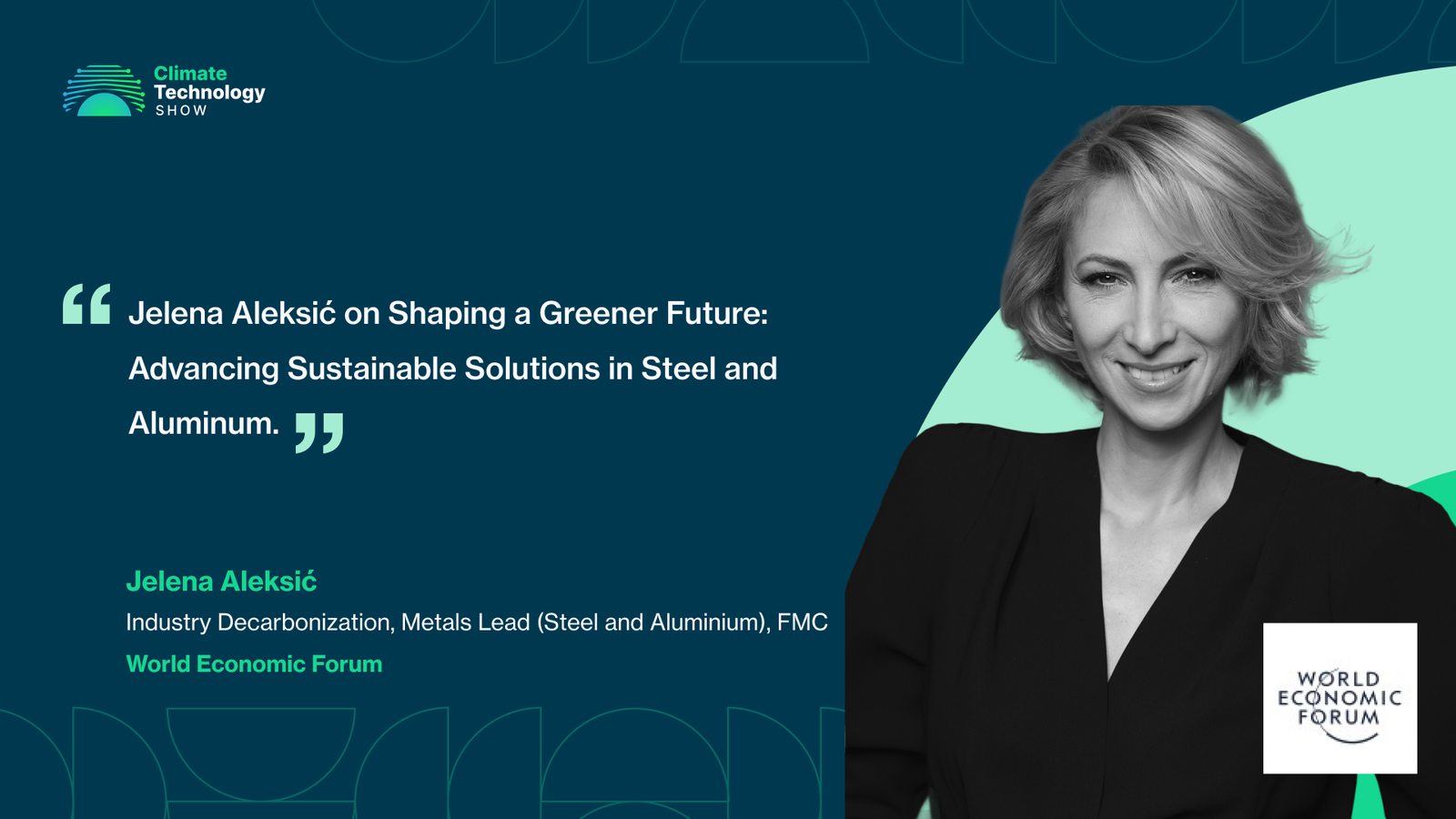
Jelena Aleksić is an experienced stakeholder management professional with a strong background in public and corporate affairs. She leads metals sector decarbonization efforts for the First Movers Coalition under the Centre for Nature and Climate at the World Economic Forum.
Before joining the Forum in early 2023 Jelena held various positions in the mining and metals sector spanning from general management to government relations and public affairs. Prior to turning to a corporate career, she was a statutory employee of the European Commission for a decade and served as a UNDP capacity building advisor to the finance minister and the Government of Serbia in early 2000.
In an engaging conversation with Jelena Aleksić from the First Movers Coalition (FMC), we delved into the critical role FMC plays in accelerating the adoption of emerging climate technologies to decarbonise heavy-emitting sectors like steel and aluminum. From leveraging corporate purchasing power to driving early market demand, Jelena shed light on how FMC is shaping a sustainable future by fostering innovation and collaboration across global value chains.
#Shaheen: Could you please describe what is the First Movers Coalition (FMC) and its key roles and how do they align with the sustainability goals?
#Jelena Aleksić: The First Movers Coalition advances the most critical, emerging climate technologies by leveraging members’ collective purchasing power. From 35 corporate members at its inception in 2021, this coalition has grown to over 100 members who have collectively made over 125 purchasing commitments. Joining the FMC provides companies with a high-impact climate action aligned with their individual sustainability goals. Together, we expect to achieve an annual reduction of 31 million tonnes of CO2e by 2030.
#Shaheen: How is FMC driving early market demand for low-carbon metals, and what specific commitments have members made in these sectors?
Jelena Aleksić: By 2050, as much as 50 percent of emissions reductions needed to achieve net zero are expected to come from technologies not yet available at scale. Building early market demand for such technologies by 2030 will be critical to catalyzing their commercial adoption. By translating member commitments into the world’s largest credible demand signal, FMC accelerates the adoption of emerging climate technologies to decarbonize the world’s heavy-emitting sectors.
In service of this mission, FMC seeks to drive bankable offtake agreements, strengthen credible demand signals, identify viable supply, and build and leverage an enabling environment. Our members have made purchasing commitments across seven sectors: aviation, shipping, trucking, cement and concrete, steel, aluminium, and carbon dioxide removal. The commitments made by the members of the First Movers Coalition are subject to the availability of material supply. Members acknowledge that procuring the materials needed to meet these commitments may come at a premium cost.
#Shaheen: As 2030 approaches, how will the First Movers Coalition measure the impact of its demand signals in fostering the widespread adoption of sustainable metals?
#Jelena Aleksić: Our members are already very active, leading the way, and are working towards fulfilling their commitments by 2030. We compile our impact briefs to inspire others at least once per year ahead of the World Economic Forum’s Annual Meeting in Davos.
Moreover, we engage with our different national and international stakeholders (public, private, philanthropic) throughout the year on-site. We use our presence in a given jurisdiction to showcase the examples of innovative offtake and collaborative partnerships across value chains. In addition, we aim to capture the key lessons learned, such as our reports from Brazil, India, and South Africa, or our thematic articles co-written with our members and institutional partners.
#Shaheen: What key role does the emerging technologies play in decarbonising metals particularly steel and aluminum and how is FMC supporting their adoption?
#Jelena Aleksić: Leading analysis indicate that the FMC aluminium commitment is most likely to be achieved with clean technologies for direct emissions reductions (such as inert anodes, carbon capture, carbo-chlorination, among other technologies) paired with low carbon power for electrified or hydrogen-ready processes. Similarly, research suggests that our goals are most likely to be accomplished with steel production using nascent and advanced green technologies (such as electrowinning, electrolyzers, carbon capture utilization and storage) and carbon capture and storage with existing processes or direct reduced iron-electric arc furnace (DRI-EAF) using zero-carbon hydrogen.
However, emerging climate technologies are highly capital intensive, requiring strong business cases that rely on the monetization of low-GHG products, which is challenging when key customers are either geographically distant from production sites or occupy different positions in the value chain. We acknowledge that mixed chain-of-custody models represent a transformative opportunity to connect the supply of low GHG products with demand, thereby unlocking the business case for investment and accelerating the deployment of innovative solutions. To be acceptable under FMC commitments, all chain-of-custody models must be designed and implemented with integrity and credibility. Safeguards such as standards, supply chain certification, registries, and reporting guidelines will be required, and models should be as interoperable with other systems as possible.