
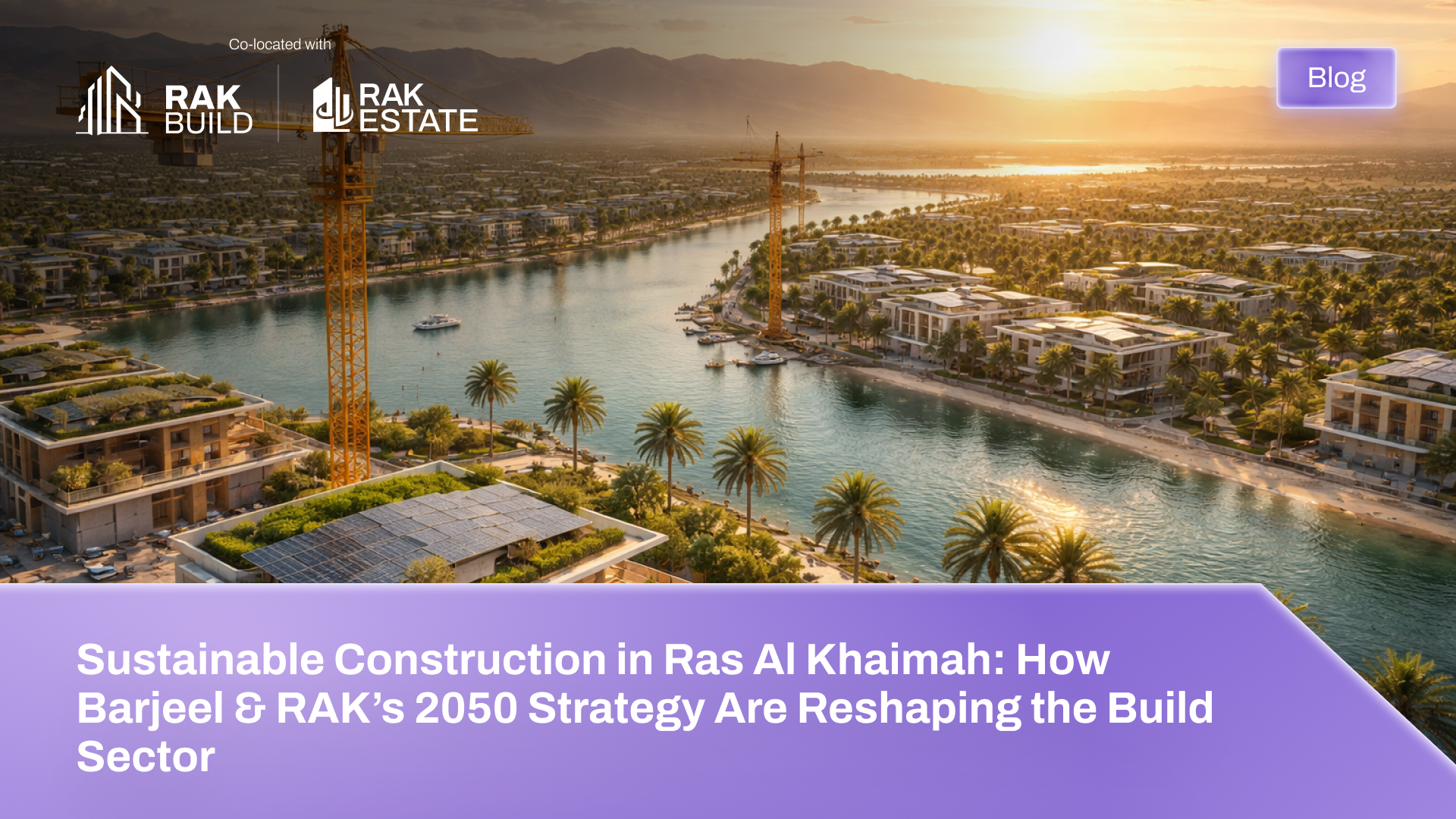
Ras Al Khaimah is no longer a quiet outlier in the UAE’s built-environment story. Over the past few years, the emirate has moved decisively to align its growth with long-term sustainability, energy efficiency, and climate resilience. At the centre of this shift are two key pillars: the Barjeel Green Building Regulations and the Ras Al Khaimah Integrated Sustainability Strategy 2050. Together, they are changing how projects are designed, engineered, and delivered across the emirate and setting a clear agenda for contractors, consultants, and developers converging at RAK Build 2026.
For the construction sector, this is no longer a branding exercise. Sustainable construction in RAK is becoming a compliance requirement, a cost-management tool, and a major competitive differentiator all at once.
Barjeel: From Concept to Construction-Site Reality
Barjeel is Ras Al Khaimah’s dedicated green building regulation framework, developed by RAK Municipality to improve the energy and water performance of new buildings while maintaining practicality for the local market. It sets mandatory minimum requirements in areas such as building envelope performance, ventilation, lighting efficiency, HVAC systems, and water use.
The objectives are ambitious but measurable. Barjeel aims to reduce energy and water consumption in new buildings by roughly 30 percent compared to a conventional baseline, with careful attention to construction cost, lifecycle savings, and ease of enforcement. Studies and guidance materials around Barjeel highlight that the incremental investment required can typically be recovered through lower utility bills over a relatively short period. For contractors and project teams, this translates into a very practical checklist of expectations on every project that falls under the regulations. Wall and roof assemblies must meet specific insulation values; glazing ratios and shading must be accounted for; efficient air-conditioning equipment and controls are no longer optional; and water fixtures, irrigation systems, and landscaping must be designed with conservation in mind.
In this sense, Barjeel is turning sustainability into a technical standard on site rather than a marketing slogan on a brochure.
RAK’s Integrated Sustainability Strategy 2050: The Bigger Picture
Barjeel does not exist in isolation. It is one of the tools implementing the broader Ras Al Khaimah Integrated Sustainability Strategy 2050, which sets long-term targets for energy efficiency, renewable energy, water savings, waste reduction, and overall emissions reduction across the emirate.
The 2050 strategy outlines sector-specific programs, including buildings, transport, industry, and waste, with the built environment identified as a major area where efficiency gains can be achieved at scale. It seeks to:
-Reduce overall energy demand through efficiency in buildings and industry
- Increase the share of renewable energy in the local mix
-Promote low-carbon development and green infrastructure
-Encourage private-sector innovation and investment in sustainable solutions
For the construction ecosystem, this long-term roadmap sends a clear signal. Projects being delivered today will operate under increasingly stringent performance expectations over their entire life. Designs that lock in high consumption or inefficient systems risk becoming stranded or expensive to retrofit later. Those aligned with 2050 goals, on the other hand, are more likely to retain value, attract tenants, and appeal to institutional capital with ESG mandates.
What This Means for Contractors and Developers on the Ground
The combined effect of Barjeel and the 2050 strategy is already visible in the way projects in RAK are scoped and executed. Sustainable construction is translating into specific choices of materials, methods, and technologies at the tender and site level.
Some of the key shifts include:
Higher-performance building envelopes Better insulation, improved airtightness, and more efficient glazing are becoming standard. This reduces cooling loads, enables smaller HVAC systems, and improves interior comfort in RAK’s hot climate.
Smarter mechanical and electrical systems High-efficiency chillers, variable speed drives, LED lighting, and advanced controls are increasingly specified to meet Barjeel thresholds and owner expectations. For MEP contractors, this means closer coordination with suppliers and consultants who understand green building performance.
Water-efficient design and landscaping Low-flow fixtures, efficient irrigation, and drought-tolerant landscaping are now essential components of compliant project design, particularly in residential and hospitality developments where outdoor water use can be significant.
Integration of renewables and on-site energy solutions While not every project will host large solar arrays, RAK’s broader sustainability strategy encourages early consideration of solar readiness, on-site renewables, and connections to future clean-energy infrastructure.
These requirements are pushing contractors, consultants, and developers to update their standard details, supplier lists, and construction processes. Companies that build internal capability in energy modelling, green product selection, and commissioning are finding themselves better placed to satisfy both regulatory and client demands.
Opportunities for Innovation and Differentiation
Although regulation can sometimes feel like an added burden, Barjeel and the 2050 strategy also open space for innovation and competitive advantage in RAK’s construction market.
First, there is a clear opportunity for specialised consultants and solution providers from energy modellers and sustainability consultants to suppliers of high-performance materials, efficient HVAC systems, façades, and smart controls. Those who understand how to deliver Barjeel-compliant, cost-effective solutions can become preferred partners to contractors and developers.
Second, contractors that embrace sustainable construction principles rather than treating them as a box-ticking exercise can market themselves as trusted delivery partners for complex, high-performance projects. Demonstrating successful Barjeel-certified buildings, lower operational costs, and smooth inspections will be powerful proof points in a competitive tender environment.
Third, for developers and master planners, aligning early-stage planning with RAK’s 2050 sustainability goals can help projects secure approvals more smoothly, attract international investors, and differentiate communities in an increasingly crowded regional market. Master developments that integrate efficient infrastructure, green public realms, and smart systems will likely be viewed more favourably by both regulators and the market.
RAK Build 2026: A Platform for the Next Phase
RAK Build 2026 arrives at a moment when the emirate’s sustainability vision is moving from policy documents to construction sites. The event gives contractors, developers, consultants, and technology providers a focused platform to understand what Barjeel and the 2050 strategy mean in practice project by project, contract by contract
For exhibitors, it is a chance to showcase building materials, systems, digital tools, and services that directly support green construction whether through better envelope performance, efficient MEP solutions, construction waste reduction, or data-driven operations. For visitors, it is an opportunity to benchmark current practices against emerging standards, learn from early adopters, and build partnerships that will shape the next decade of building in Ras Al Khaimah.
As sustainability tightens its grip on regulations, investment criteria, and market expectations, events like RAK Build 2026 become more than just trade shows; they become working laboratories where the future of construction in RAK is negotiated and refined in real time.
For those willing to adapt, sustainable construction in Ras Al Khaimah is not just a compliance story; it is a growth story.