Rethinking Neurodegenerative Disease Treatment: A Conversation with Alan Palmer, CEO of Elixa Mediscience

First published onBio Technology Show ↗
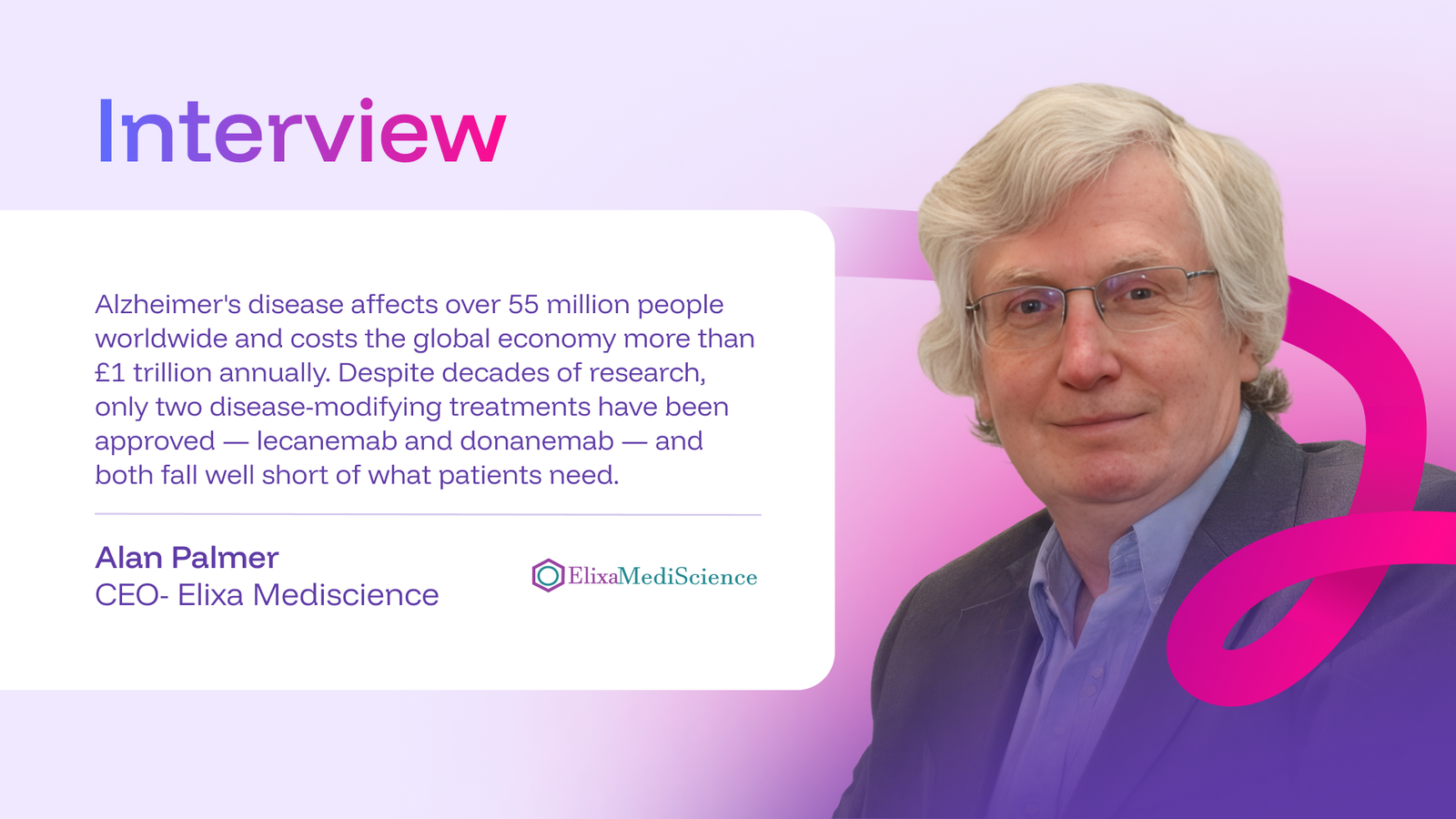
As the search for effective treatments for neurodegenerative diseases accelerates, biotechnology innovators are rethinking traditional approaches to drug discovery. Alan Palmer, CEO of Elixa Mediscience speaks with Muhammad Younis about the scientific advances, challenges, and opportunities shaping the future of neurological care.
#LBS: The biotechnology sector is increasingly shifting from symptom management towards disease-modifying therapies. How do you see this transition reshaping the future of care for conditions such as Alzheimer's and Parkinson's disease?
Alan Palmer: We do not yet have drugs that slow the progression of Alzheimer's or Parkinson's disease in a clinically meaningful way. What is needed is a transition towards new medicines that specifically slow the progressive loss of neurons – pyramidal cells in Alzheimer's, and nigrostriatal neurons in Parkinson's. If such medicines prove safe and well tolerated, they could not only slow disease progression but also delay disease onset, particularly as major improvements in biomarkers enhance our ability to diagnose these diseases earlier.
#LBS: Translating promising scientific discoveries into clinically viable treatments is often a long and complex journey. What have been some of the key scientific, regulatory, or commercial challenges in advancing novel therapies for neurodegenerative diseases?
Alan Palmer: Big companies often suffer from groupthink, which is why new ideas are increasingly coming from the biotech sector. However, securing seed funding for European biotech companies is frequently difficult due to a fragmented and risk‑averse venture capital market. This creates a "funding gap": early‑stage capital is insufficient to bridge the costly journey from a promising proof‑of‑concept to late‑stage clinical development, especially for rounds in the critical €5–15 million range. In contrast, investors back in the day — such as Sir Chris Evans — were prepared to take a punt if the science was sound and the potential market was tractable.
#LBS: What scientific gaps or limitations in current treatment approaches for Neurodegenerative diseases inspired Elixa's mission, and how is your company seeking to address them differently?
Alan Palmer: Alzheimer's disease affects over 55 million people worldwide and costs the global economy more than £1 trillion annually. Despite decades of research, only two disease-modifying treatments have been approved — lecanemab and donanemab — and both fall well short of what patients need. Each offers only modest slowing of disease progression, causes serious brain-imaging abnormalities (ARIA) in around 30% of patients, requires regular hospital infusions, and costs more than $25,000 per patient per year — a price the NHS has declined to pay. More fundamentally, neither drug tackles the underlying causes of neuronal death: oxidative stress, neuroinflammation, and mitochondrial dysfunction. No oral disease-modifying therapy exists. Elixa believes the field has been looking at the problem the wrong way. Where current drugs target a single pathway, Elixa's lead compound takes a multimodal neuroprotective approach — addressing the root drivers of cell death simultaneously, in a single oral treatment.
#LBS: Looking ahead, what developments in neuroscience, biotechnology, or drug discovery are you most excited about, and what would success look like for Elixa in the coming years?
Alan Palmer: The developments I find most exciting are those that treat the brain as what it actually is — a dynamic, self-organising prediction system rather than a collection of discrete molecular targets. In drug discovery, the shift towards multimodal neuroprotection is long overdue: the failure of single-target amyloid and tau strategies has made it clear that neurodegeneration is a systems-level problem requiring systems-level solutions, and compounds that simultaneously address oxidative stress, neuroinflammation, and mitochondrial dysfunction represent a genuine paradigm shift. Alongside this, the convergence of precision psychiatry, AI-driven biomarker discovery, and blood-based diagnostics — particularly plasma phospho-tau and neurofilament light chain — is opening the prospect of intervention years before symptoms appear, which is almost certainly where the therapeutic window lies. For Elixa, success in the coming years looks like this: a lead compound that clears Phase II with a clean safety profile and a signal of genuine disease modification — not just slowing of decline, but stabilisation; an oral formulation that makes treatment accessible beyond specialist centres; and ultimately a therapy that NICE can approve and the NHS can afford to deliver at scale, reaching the millions of patients for whom current options offer little more than hope deferred.
#LBS: As the biotechnology industry enters a new era of innovation, what opportunities do you believe events such as the London Biotechnology Show create for fostering collaboration, investment, and progress in tackling some of healthcare's most pressing challenges?
Alan Palmer: Events like the London Biotechnology Show matter precisely because the most pressing challenges in healthcare — neurodegeneration, treatment-resistant psychiatric illness, chronic pain, cancer — are not going to be solved by any single company, discipline, or funding stream working in isolation. The opportunity these events create is one of productive collision: between the academic scientist who has identified a target and the biotech that has the chemistry and drug discovery expertise to exploit it; between the early-stage company with compelling preclinical data and the investor who understands the neuroscience well enough to back it before Phase II; between the clinician who knows what patients actually need and the drug developer who has been optimising for a trial endpoint rather than a lived outcome. In a field where the distance between a promising compound and an approved therapy is measured in decades and billions of pounds, the informal conversations that happen at the margins of a conference — the introduction that becomes a licensing deal, the panel discussion that surfaces a regulatory pathway no one had considered, the chance encounter between two researchers working on opposite sides of the same problem — are not peripheral to the science. They are part of how science moves. For a company like Elixa, with a multimodal neuroprotective approach that cuts across conventional therapeutic boundaries, that kind of cross-disciplinary exchange is not just valuable — it’s essential.