Insightful Q&A Session With Carlo Iacovini, General Manager of Energica Inside.
First published onLondon EV Show ↗
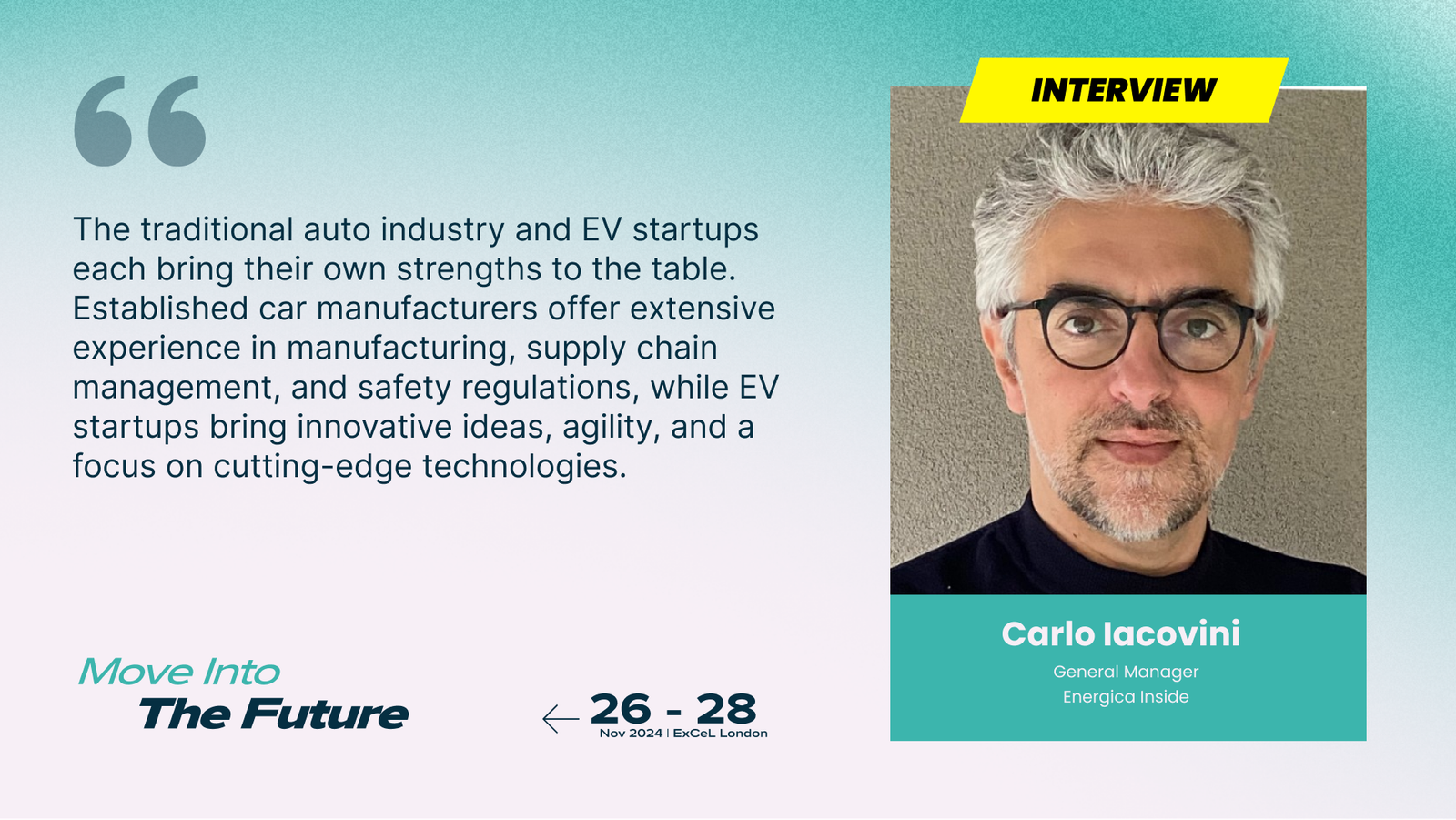
We are excited to present an insightful Q&A session with Carlo Iacovini, General Manager of Energica Inside. With over 25 years of experience in business development, product management, sales, and marketing within the mobility industry, Carlo brings a wealth of knowledge and expertise to the table. His extensive career has spanned both city-level and international landscapes, where he has successfully managed companies, deployed services, and opened new markets. Specializing in new mobility, public transport, and automotive sectors, Carlo has been a driving force in shared and digital mobility as well as electric vehicle technology.
This engaging session, conducted by Imran Mushtaq, explores Carlo's insights on leveraging data from electric vehicles, the collaboration between the EV industry and energy providers, the future of battery technologies, the integration of traditional automotive knowledge with innovative EV startups, and the role of industry events like the London EV Show in accelerating the adoption of electric vehicles.
#LEVS: Beyond environmental benefits, electric vehicles offer unique opportunities for data collection and analysis. How can this data be leveraged by the EV industry to create a more sustainable and efficient transportation ecosystem, considering both public and private sectors?
#Carlo Iacovini: We can say that data is the new “oil,” along with electricity, of course!
Electric Vehicles (EVs) aren’t just about cleaner air; they offer a treasure trove of data that can really revolutionize transportation. By leveraging this data, the EV industry can achieve three main goals, benefiting both the public and private sectors:
Optimizing Charging Infrastructure: Data on charging patterns can pinpoint high demand areas for new charging stations and help develop dynamic pricing strategies to encourage off-peak charging and reduce grid strain.
Predictive Maintenance: By analyzing vehicle sensor data, dealerships and service centers can predict potential issues before they turn into breakdowns, minimizing downtime and extending vehicle life.
Smart Traffic Management: Aggregated vehicle location data can optimize traffic light timings and reroute traffic in real-time, reducing congestion and emissions. Public-private partnerships can use this data to create intelligent transportation systems.
These three main topics will help create a more sustainable and efficient future for sure.
#LEVS: Shared mobility models are often hailed as a potential solution for urban congestion. However, concerns exist regarding the impact of a large number of EVs on electricity grids. How can the EV industry collaborate with energy providers to ensure a smooth transition to a future dominated by shared electric vehicles?
#Carlo Iacovini: Shared mobility models with EVs have significant potential, yet valid concerns about the grid remain. The EV industry and energy providers can collaborate for a seamless transition: Through innovative Vehicle-to-Grid (V2G) Technology, EVs serve as mobile batteries, feeding power back to the grid during peak times, encouraging EV ownership and stabilizing the grid.
Integrating charging stations near renewable energy sources like solar and wind reduces reliance on traditional power plants, fostering a cleaner energy ecosystem through strategic collaboration. Additionally, implementing Smart Charging Solutions, adaptable to grid conditions and user needs, alleviates peak demand and facilitates a smoother transition to shared electric vehicles. By synergizing efforts, the EV industry and energy providers can effectively address concerns and chart a course towards a more sustainable future.
#LEVS: While lithium-ion batteries are currently dominant, there's active research into alternative battery technologies. From a business development standpoint, what are the key factors that can be considered when evaluating the potential of emerging battery technologies for future EV applications?
#Carlo Iacovini: Right now, lithium-ion batteries are the go-to choice, but the future holds exciting possibilities. When exploring new battery technologies, several key factors come into play. Firstly, Energy Density—how much energy a battery can store relative to its size or weight. Higher density means EVs can travel farther on a single charge.
Secondly, Charging Speed—how quickly a battery can be charged. Faster charging enhances the user experience and reduces concerns about running out of power. Next, Cost and Sustainability—are critical considerations. It's essential to evaluate the production cost, raw material sourcing, and the environmental impact of battery disposal. Lastly, Safety—is paramount. Assessing how well a battery performs under extreme conditions and the potential fire risks ensures they operate safely in real-world scenarios.
By carefully evaluating these factors, we can identify the most suitable batteries for the future of EVs.
#LEVS: Your experience spans both traditional automotive and new mobility. How can the knowledge and expertise from established car manufacturers be best integrated with the innovative spirit of new EV startups to accelerate the industry's progress?
#Carlo Iacovini: The traditional auto industry and EV startups each bring their own strengths to the table. Established car manufacturers offer extensive experience in manufacturing, supply chain management, and safety regulations, while EV startups bring innovative ideas, agility, and a focus on cutting-edge technologies. By collaborating through joint ventures, technology licensing, and shared platforms, they can create a win-win situation, leveraging their respective strengths to accelerate progress in the industry.
#LEVS: Events like the London EV Show connect diverse EV players. How do these events accelerate solutions for charging, batteries, and consumer adoption?
#Carlo Iacovini: Events like the London EV Show are pivotal in fast-tracking solutions for the future. They serve as a hub where EV manufacturers, energy providers, policymakers, and consumers come together, fostering collaboration and knowledge exchange. These gatherings also serve as a platform to showcase cutting-edge innovations in charging technology, batteries, and user experiences, attracting investors and generating excitement among consumers. Moreover, they facilitate industry discussions that identify and address key challenges in EV adoption, paving the way for solutions and policy changes that ensure a smoother transition to a sustainable future.